In My Words: Meet the Leads – Dr. Kyle Goldberger | Neurologist and Epilepsy Specialist
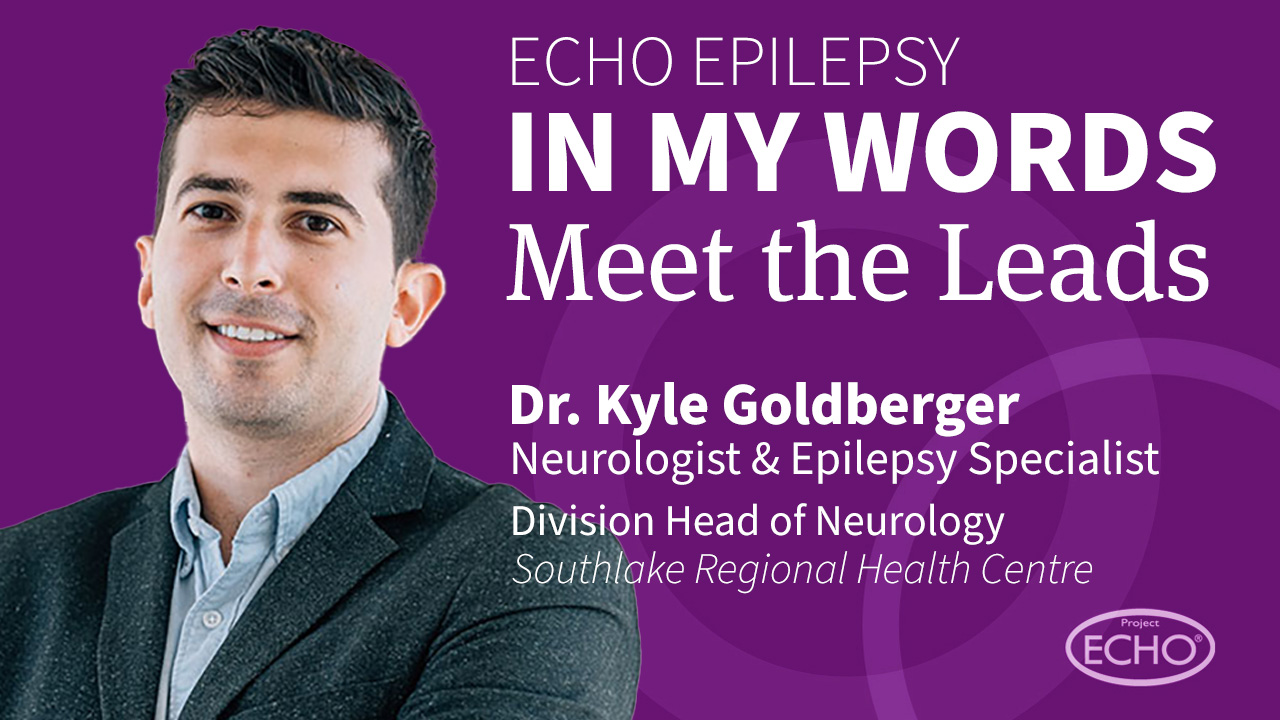
Dr. Kyle Goldberger is an Epilepsy Specialist and Neurologist, practicing out of Southlake Regional Health Centre, where he serves as Division Head, and at Toronto Western Hospital, as a Clinical Associate.
Beginning as a Fellow, Dr. Goldberger embraced ECHO’s collaborative spirit, which enriched his practical learning and professional growth. Now in practice Dr. Goldberger contributes as a leader in the adult epilepsy stream, where he continues to inspire and support others. His story highlights the program’s unique ability to foster a supportive network, transforming individual experiences into collective success in epilepsy care. Dr. Goldberger completed his neurology residency in 2022 at Queen’s U, followed by an Epilepsy/EEG fellowship at the U of T (Toronto Western Hospital).
Where did you grow up and where did you complete your medical training?
I grew up in Toronto. I did my undergrad in London, my medical school in Hamilton and my residency in Kingston. So it was nice, nice to be back in Toronto or GTA area [for my fellowship and practice], to be with friends and family.
What is your current position and where do you practice?
I’m a neurologist and epilepsy specialist, practicing mostly in Southlake Regional Health Center in Newmarket. I also practice out of Toronto at Western Hospital and work with the EEG program with Michael Garron Hospital.
Why did you choose neurology and epilepsy as your specialties?
It’s a good question because there’s so many different ways to answer that. But I think fundamentally it’s a fascinating part of medicine and health care. It’s a very huge part of who we are. And the conditions that are neurological conditions are really impactful on a person’s life and quality of life. And then what’s really special about epilepsy is you’re seeing people across the spectrum of their lives. So, from childhood or from their younger years, to people my age, people at the beginning of their careers or trying to plan a family, to older adults and so on and so forth. So there’s something nice about working with people through those stages and helping people achieve the kind of the quality of life that they’re trying to achieve. And the other thing that’s nice about [caring for people with] epilepsy is it’s a very subjective type of experience in many ways. So you really have to spend time listening to people, what are their seizures, what are their goals? It’s rewarding working with people in that type of space.
What drives and inspires you about your work?
The impact you’re able to make on people’s lives, in what they’re living through, a chronic condition or a juncture in their life where they had a seizure or something along those lines. And then zooming out from a broader kind of systems level perspective, setting up a clinic or a healthcare system that can support people in in your local community.
How did you become involved in the ECHO program?
That’s been an interesting experience for me because, I first learned about ECHO as a resident through Dr. Lisa Lomax, who was my program director in Kingston. I was on the audience end of ECHO, taking away pearls and learning through the didactic sessions and then over time I started to share some cases that I came across in residency. And then when I came to my fellowship, I was actually providing some of the didactic sessions and participating on the other end, providing my own personal advice and professional experiences. And I’ve continued to kind of escalate my involvement with ECHO.
What do you find particularly inspiring and helpful about the ECHO model?
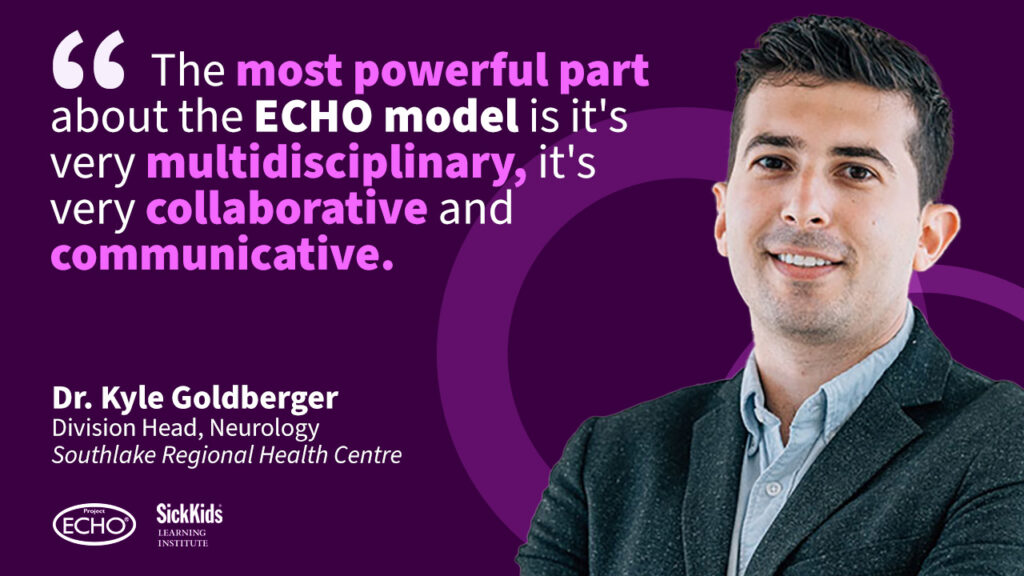
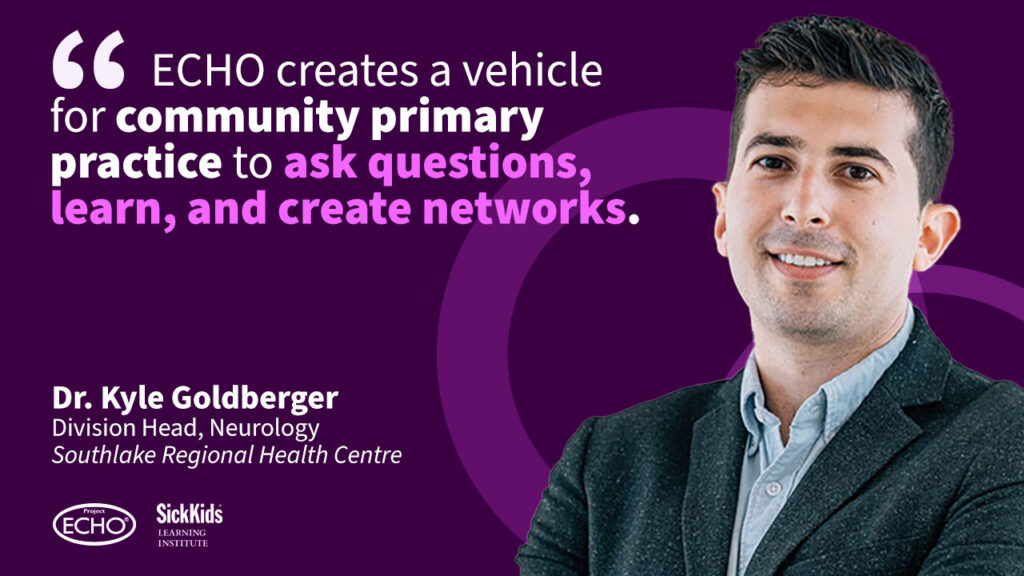
The ECHO model is unique because it’s fundamentally collaborative and communicative. For example, a family doctor who was cordial enough to ask questions and then take those pearls and professional advice back to his own practice, to the index patient case that he was thinking of. That’s something I’ve seen repeatedly throughout ECHO. I’ve benefited from that, and I’ve contributed to that from the other end. And I think that’s probably the most powerful part about the ECHO model, it’s very multidisciplinary, it’s very collaborative and communicative. You’re always able to get some pearls from the didactic sessions and interface with people. But realistically, that group conversation aspect is unique to ECHO, and it’s very high yield.
Has the ECHO program impacted your clinical practice?
Yes, it has more and more recently. One of the highest yield learning experiences for me is actually teaching now that I have finished my fellowship; and being asked to do the presentation on women’s issues and epilepsy. I still go back to the reference articles in the literature and try marry what’s in the literature with my own professional experience. People ask questions that you may not have thought of, and trying to navigate those with your colleagues; those have been the highest yield learning experiences for me. Obviously as a resident and even as a fellow, hearing other people’s pearls and experiences has also been very useful.
Have you seen ECHO have a positive impact on patient care?
What’s really nice about ECHO is that it’s really a broad selection of professional backgrounds and geographic backgrounds. So people are always asking questions with reference to their own experiences. I’m bringing back things to my to my practice that I’m learning from [ECHO]. A lot of medicine is in that grey zone where everyone is so individualized and circumstances are always so nuanced, that it’s impossible to study something and have that uniformly apply. So being able to work through that with your colleagues and to see other real-world examples is very relevant and there’s always something that you can bring back.
How do you see the ECHO program fitting within the realm of e-health services, particularly in primary care for epilepsy patients?
Well, that’s an interesting point because if it’s not formally developed [as an e-health service]. If you look at how ECHO actually functions, there’s always the person who brings the case and prepares it. But inevitably there’s another person who’s been sitting on a case, just waiting for that ECHO session so they can pick everyone’s brain. So you can imagine there’s a space for it. And it’s nice to hear that it’s expanding into other parts of the provinces. Where I practice in Newmarket, for example, in terms of community epilepsy specialists, I’m very sensitive to the fact that north of Newmarket, there’s no other [community epilepsy specialists] in neighboring counties like Muskoka, Simcoe – there’s no epilepsy practices. And a lot of people are either not getting care independently or are waiting to be sent to Toronto Western [specialists]. So I think ECHO would be an excellent forum for that. And the fact that people are connecting informally already [through ECHO] is probably a testament that there’s a space for that and an opportunity.
Have you developed any notable professional relationships through the ECHO community?
It’s funny because we’re in that post, I don’t know if it’s really post-COVID or whatever it is, but we’re allowed to be face to face [again]. And one of the things that’s really great about ECHO is it was an opportunity to meet the people who actually work where I was working in the epilepsy space and then see them, quote unquote, face to face, you know, the pharmacists, the social workers, people who you’re not interfacing with regularly because of the way our work has changed.
And so, now when I walk by them, I know them and we say “hi” and I can chat with them. And I think that’s probably been the most impactful; the collegial aspect, seeing your colleagues and participating actively in a case as opposed to through an email or through an Epic message saying, “can you please see this person”, to actually get to see their thoughts and also [gain] pearls from them and professional advice.
How would you explain the ECHO program to another healthcare colleague?
I’d say, it’s a very collaborative model, you’re coached in a very safe environment, people from all backgrounds, all different types of health care providers are in the same place. And they all feel comfortable sharing their questions, their gaps in knowledge. And I think if you’re receptive to being in that type of setting and being someone who’s comfortable asking those types of questions and acknowledging that everyone has a different lens or different piece of advice, it’s a very high yield experience. And even if the case itself or the didactic session isn’t exactly what you were looking for, it’s so multifaceted. There’s so many co-morbidities and different lenses to take that inevitably one topic which was supposed to be discussed will be leading to another one. The main kernel of value for that would be that the collaborative aspect, bringing in your own issues, receiving advice from other people.
In My Words: Our Community of Practice
Testimonials from Healthcare Providers who have participated in and benefitted from ECHO Epilepsy programs